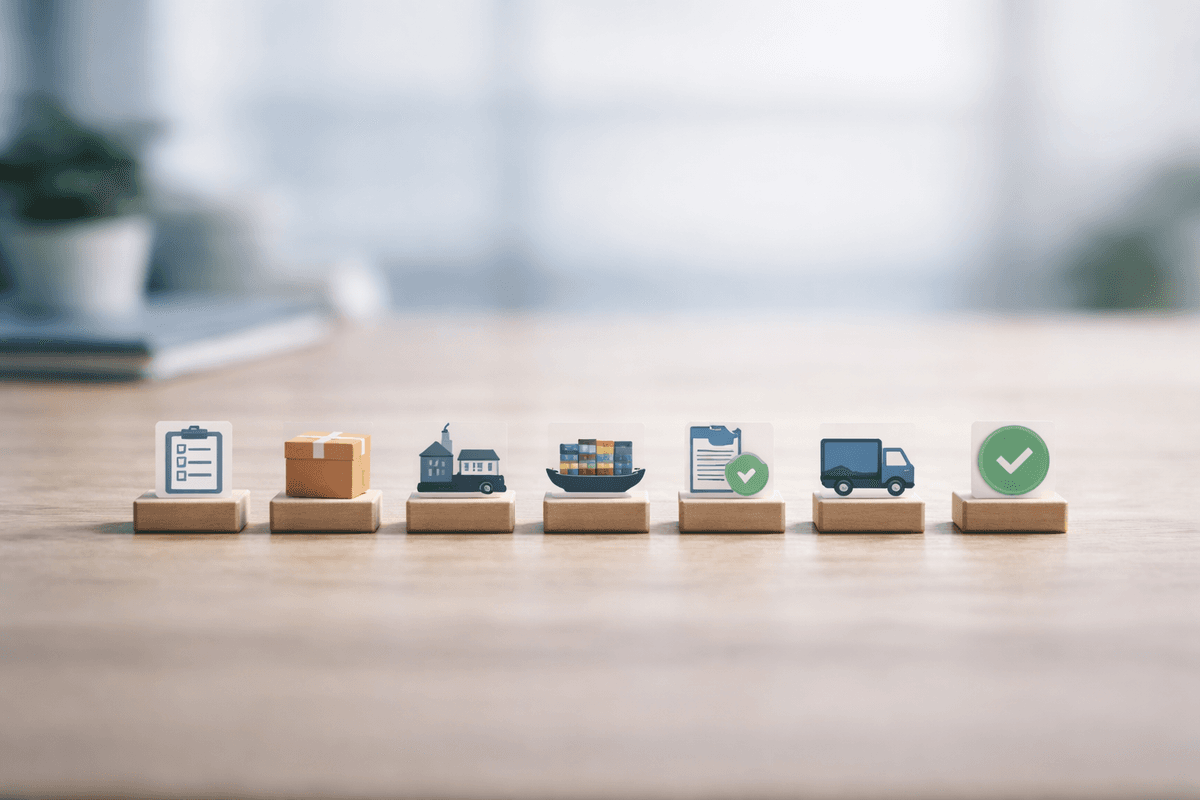
Most DTC brands track two moments in the life of an import order: the day they place it and the day it ships. Everything in between is a black box.
I know because I operated this way for years. I'd send a purchase order to my factory in China, get a "received" reply, and then essentially wait until someone told me the goods were on a boat. If I was disciplined, I'd follow up every couple of weeks to ask how things were going. If I was busy — which was always — I wouldn't hear anything until the freight forwarder reached out to book the shipment. Or until something went wrong.
The problem with tracking only two milestones is that by the time you find out about a problem, it's already too late to fix it cheaply. A production delay you catch in week two costs you a conversation. A production delay you catch in week eight costs you an air freight bill.
After 15 years of importing and more of these surprises than I'd like to admit, I've learned that every import order — regardless of product, factory, or country — moves through seven distinct milestones. Not two. Seven. And the brands that track all seven are the ones that stop getting blindsided.
The seven milestones
Here's the full lifecycle of an import order, from the moment you decide to place it to the moment it hits your warehouse.
1. Order
This is where most brands start and stop paying attention. You send a purchase order to your vendor — quantities, specs, pricing, delivery timeline. The vendor acknowledges receipt.
Most founders treat this as a single event: "I placed the order." But the order milestone is really about ensuring that what you sent is complete and unambiguous. Does the PO include the correct packaging specs? The right UPC codes? The updated artwork file? If there's a discrepancy between what you think you ordered and what the factory thinks you ordered, this is the cheapest moment to catch it.
2. Confirmation
This is the milestone almost every brand skips entirely. Confirmation isn't the vendor saying "got it." Confirmation is the vendor formally agreeing to your pricing, quantities, timeline, and specifications — and you having a record of that agreement.
Without a formal confirmation step, you're operating on assumptions. The factory might have mentally adjusted your delivery date based on their production schedule. They might have questions about a spec but figured they'd sort it out later. You think the order is locked. They think it's still flexible.
I've had orders where the factory started production on a different colorway than what I specified because they "assumed" I'd want the same one as last time. There was no confirmation step where we explicitly agreed on specs. It cost me a six-week delay and a partial reorder.
3. Production
This is the biggest blind spot in the entire import lifecycle, and it's where I've lost the most money over the years.
Production is not a single event — it's a window that typically runs four to twelve weeks depending on your product. And during that window, most brands have zero visibility into what's happening. Your factory could be on schedule. They could be three weeks behind because they took on a bigger client's order first. They could have run into a raw material shortage. You won't know unless you ask, and most founders don't ask often enough.
I once had a factory go completely silent for three weeks during what was supposed to be a six-week production run. When I finally tracked down my contact, they told me production hadn't started yet because the raw material supplier was late. My "six-week" timeline was now ten weeks, I had inventory commitments I couldn't meet, and I had to air-freight a portion of the order at four times the cost to avoid stockouts.
If I had been tracking production as a formal milestone — with check-in points, photo updates, and progress reporting — I would have known within the first week that something was off. Instead, I found out at week five.
The production milestone should include at least one mid-production check-in. For larger orders, I'd recommend a check-in at 25%, 50%, and 75% completion. This doesn't have to be complicated — a photo of the production line, a count of units completed, a confirmation that the timeline is on track. Simple updates that take five minutes but save you thousands.
4. Quality control
QC is the milestone that separates professional importers from everyone else. If you're not inspecting your goods before they leave the factory, you are gambling with every single shipment.
A third-party QC inspection typically costs $200 to $400. Shipping a container of defective product and dealing with the fallout — returns, refunds, re-orders, lost customers, damaged reputation — costs tens of thousands. The math is not complicated.
But here's what most brands get wrong about QC: they treat it as a pass/fail gate at the very end of production. By the time your inspector shows up, the goods are already packed and staged for shipment. If they find a problem, your only options are expensive ones — rework at the factory (which delays everything), accept the defects and deal with customer complaints, or reject the shipment entirely and start over.
The QC milestone works best when it's connected to the production milestone. If your factory is sending production updates, your QC inspector can plan their visit at exactly the right time — when enough units are complete to inspect a representative sample, but early enough that problems can be fixed before the entire run is finished.
5. Ready
This milestone is invisible to most brands, but it's where a surprising number of shipments get delayed.
"Ready" means your goods have passed QC, are packed into their export cartons, and are physically ready for pickup at the factory. This sounds simple, but the gap between "QC passed" and "goods are actually ready to ship" can be days or weeks — and during that gap, things fall through the cracks.
Your freight forwarder needs to know when goods are ready so they can book the right vessel or truck. If nobody tells them, the booking doesn't happen. If the booking doesn't happen, your goods sit in the factory's warehouse waiting for a container. If they sit too long, they might miss the next available sailing, and suddenly you're a week or two behind schedule for no reason other than a communication gap.
The "ready" milestone is really about handoff — it's the moment when responsibility transitions from your vendor to your logistics partners. Without explicitly marking this moment, that handoff happens informally and things get missed.
6. Ship
This is the second milestone most brands track — and they track it because the freight forwarder usually sends them a bill of lading or booking confirmation.
Shipping is more than just "it's on a boat." This milestone should capture the vessel name, the sailing date, the estimated arrival date, the container number, and the bill of lading number. These details matter because they're what your customs broker needs to clear the goods, and they're what you need to plan your receiving and warehousing.
The most common problem at this stage isn't a lack of information — it's that the information is scattered. Your freight forwarder sends the booking confirmation to your ops person. The bill of lading goes to the email address on file, which might be your old assistant. The arrival notice goes to your customs broker. You end up chasing four different documents across three different people's inboxes to answer the simple question: "When is my stuff arriving?"
7. Deliver
The final milestone. Your goods clear customs, arrive at your warehouse, and you do a receiving check against the packing list. Order complete.
Except it's not really complete until you close the loop. Did the quantities match? Did the goods arrive in good condition? Were there any discrepancies between what was ordered and what was delivered? This information feeds back into your next order with this vendor. If you don't capture it, you lose the institutional memory — and you're likely to repeat the same problems on the next round.
Why this framework matters
When you lay out all seven milestones, something becomes obvious: the five milestones in the middle — Confirmation, Production, QC, Ready, and Ship — are where all the expensive problems happen. And they're exactly the ones most brands don't track.
That's not because founders are careless. It's because there's no natural system for tracking them. Email doesn't give you a timeline. Spreadsheets require someone to manually update them. WhatsApp threads disappear into the scroll. The tools we use don't have the concept of milestones built in, so we default to tracking what's easiest: "I ordered it" and "it shipped."
This realization is exactly why I built Tackr around these seven milestones. Every order in Tackr moves through seven stages — Order, Confirm, Production, QC, Ready, Ship, Deliver — and every partner involved in the order can see where it stands. Your vendor confirms the order inside the system. Your QC inspector uploads their report at the QC stage. Your freight forwarder updates the shipping details. Nobody has to ask "where is my order?" because the answer is always visible.
I didn't invent these milestones. They're how every import order naturally progresses, whether you're tracking them or not. I just built a system that makes them impossible to skip.
If you're running your supply chain on email and spreadsheets and you're only tracking two of these seven milestones, you're flying blind through the most expensive and risky part of the process. You don't need Tackr to start tracking all seven — you could do it with a better spreadsheet and more discipline. But if you want a system that does it for you and keeps every partner on the same page, that's what we built.
About the Author
Richard Stanton is the founder of Tackr, a supply chain collaboration platform for DTC brands that import goods from overseas. Over 20+ years he has founded and scaled multiple companies across e-commerce, consumer goods, technology, and cybersecurity — with seven appearances on the Inc 500 list. His 15+ years of hands-on importing from Asia, including running a dedicated factory in China, is exactly why he built Tackr.