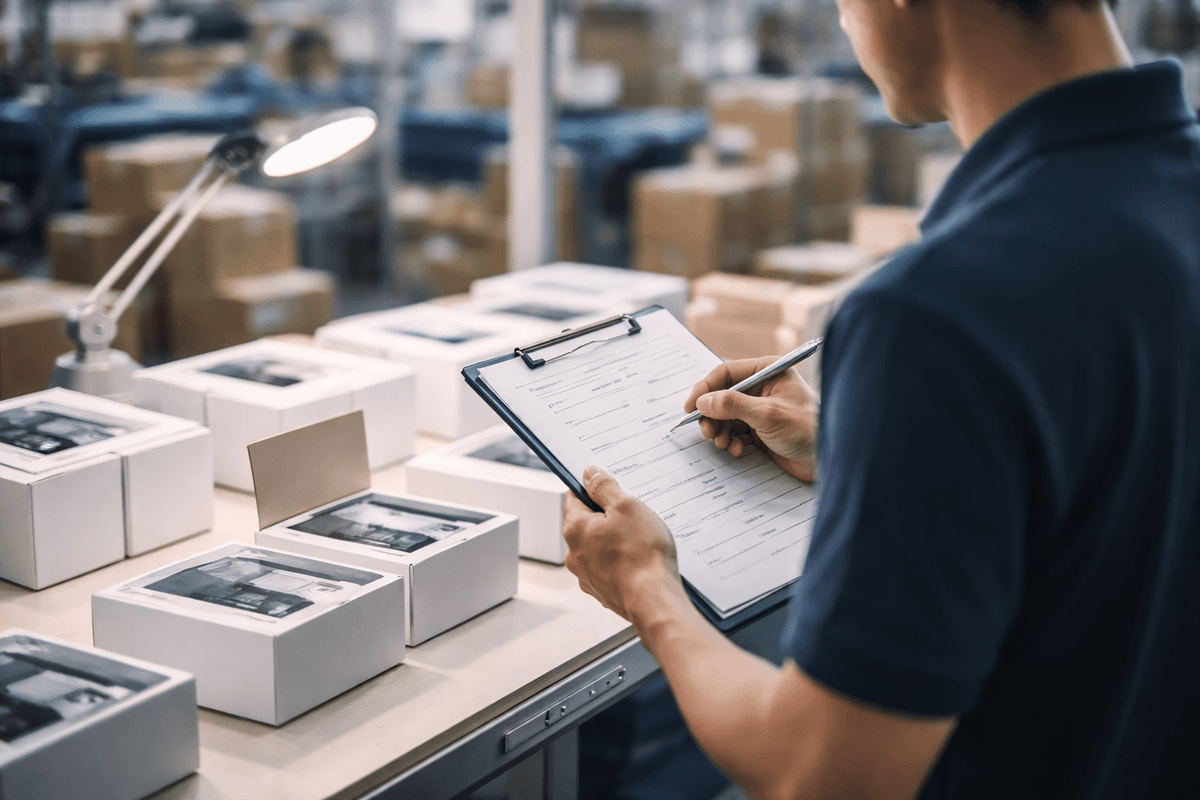
You've placed your order with a factory in China. Production is wrapping up. In a few weeks, a container full of your product will be on a vessel headed to your warehouse. The question is: do you actually know what's inside that container?
Most DTC brands importing from Asia fall into one of two camps. The first camp doesn't inspect at all — they trust the factory, cross their fingers, and deal with problems when the goods arrive. The second camp hires an inspector but doesn't prepare them properly, so the inspection catches obvious issues but misses the ones that actually matter.
Both approaches cost money. Here's how to do it right when you can't be there in person.
Why you need a third-party inspector
Your factory almost certainly has an internal QC process. Most factories do. And for established relationships where you've completed dozens of orders with consistent quality, relying on factory QC as a first line of defense is reasonable.
But factory QC and third-party inspection serve different purposes. The factory's QC team works for the factory. Their incentive is to ship goods on time and keep the production line moving. A third-party inspector works for you. Their incentive is to find problems before those problems become your problems.
The best approach is to use both. Let the factory run their own QC process during production — this catches the obvious issues early and keeps the defect rate down. Then bring in a third-party inspector to verify the results independently before the goods ship. Think of it as trust but verify.
For a DTC brand shipping containers from Asia, a third-party inspection typically runs between $350 and $800, depending on the product complexity, the location of the factory, and the scope of the inspection. Companies like QIMA and Asia Inspection are well-known providers that operate across China and Southeast Asia. They have inspectors on the ground who can be at most factories within a day or two of booking.
Compare that cost to what happens when a container of defective product arrives at your warehouse: customer returns, refund processing, potential chargebacks, reputational damage, and the cost of reordering. A single bad shipment can easily cost tens of thousands of dollars. The inspection is insurance that pays for itself every time.
When to schedule the inspection
Timing depends on your product and your order size, and getting it wrong is one of the most common mistakes brands make.
For most consumer goods orders, the standard approach is a pre-shipment inspection — scheduled when approximately 80% of production is complete and the goods are being packed. At this point there are enough finished units to pull a statistically meaningful sample, but production isn't so far along that fixing problems becomes prohibitively expensive.
For larger orders or products with higher defect risk, consider adding an inline inspection during production — typically around the 30-40% completion mark. This catches systemic issues early. If the factory is using the wrong material, applying the wrong finish, or assembling a component incorrectly, you want to know at 30% completion, not 80%.
For smaller, straightforward reorders from a trusted factory, a single pre-shipment inspection is usually sufficient.
The worst timing? After the goods are fully packed, palletized, and staged for container loading. At that point, if the inspector finds a problem, your only options are expensive ones: unpack and rework (adding weeks to your timeline), accept the defects, or reject the entire shipment.
What separates a useful inspection from a wasted one
This is where most brands fail, and it has nothing to do with the inspector. It has everything to do with preparation.
The majority of DTC brands hiring a third-party inspector for the first time send a booking request with their purchase order and say, essentially, "inspect it." The inspector shows up, pulls samples, checks for obvious defects, and sends back a generic pass/fail report. The brand feels good about it. But the inspection didn't check the things that actually matter for their specific product — because nobody told the inspector what to look for.
A useful inspection requires three things prepared before the inspector arrives at the factory:
A detailed checklist specific to your product. This isn't a generic quality form. It's a document that lists exactly what the inspector should check, specific to your product. For a consumer electronics product, that might include button functionality, screen clarity, and battery retention. For apparel, it might be stitching density, color matching against a Pantone reference, and wash label accuracy. For a packaged food product, it might be seal integrity, label placement, and expiry date printing.
Photos of golden samples and reference specifications. Your inspector needs to know what "correct" looks like. Send photos of your approved sample — multiple angles, close-ups of key details, packaging layout. Include your spec sheet with dimensions, weights, and material callouts. The more specific your reference material, the more useful the inspection. An inspector checking a product against a detailed photo reference catches things that an inspector working from a text description alone will miss.
Pass/fail criteria with defined tolerances. Not everything is black and white. A minor scratch on the bottom of a product might be acceptable. A scratch on the front is not. A 2mm variance in dimensions might be fine. A 5mm variance is a defect. Define your tolerances in advance so the inspector isn't making judgment calls on your behalf. Specify what constitutes a critical defect (reject the shipment), a major defect (needs attention), and a minor defect (acceptable within limits).
Understanding AQL sampling
Most third-party inspections use AQL — Acceptable Quality Level — as the statistical framework for sampling. AQL determines how many units the inspector pulls from your total order and what defect rate is acceptable.
The standard for consumer goods is typically AQL 2.5 for major defects and AQL 4.0 for minor defects. This means the inspection will accept a shipment if the defect rate in the sample falls below these thresholds.
AQL is a solid starting point, but it shouldn't be the only thing you rely on. AQL is a statistical tool — it tells you the probability that a batch meets a quality threshold. It doesn't tell you whether the specific defects that matter most to your customers are present.
Customize your inspection beyond standard AQL by adding specific checks that aren't part of the default protocol. Packaging accuracy is a prime example. Standard AQL sampling checks the product itself, but the most commonly overlooked defects aren't product defects at all — they're packaging errors. Wrong UPC codes, incorrect carton markings, labels that don't match the retailer's requirements, barcodes that won't scan. These are the defects that cause chargebacks, rejected shipments at the warehouse, and hours of manual relabeling.
Add packaging and labeling verification as explicit line items on your inspection checklist. Have the inspector scan every barcode variant, verify carton marks against your shipping requirements, and confirm that the packaging matches your approved artwork — not just "close enough," but exact.
Building a repeatable QC process
The first inspection is the hardest because you're building the checklist, the reference materials, and the criteria from scratch. After that, each subsequent inspection with the same product becomes faster and more targeted because you're refining based on what you learned.
After every inspection, review the report and update your checklist. If the inspector found a recurring minor defect, add it as a specific check point. If a certain measurement was consistently within tolerance, you might deprioritize it. Over time, your inspection checklist becomes a living document that reflects the real-world quality patterns of your specific factory and product.
The brands that get the most value from QC inspections aren't the ones that spend the most money on them. They're the ones that prepare thoroughly, communicate clearly with their inspector, and treat each inspection as an opportunity to improve the process for next time.
When your inspector, your factory, and your team are all working from the same checklist, referencing the same specs, and reporting into the same system, QC stops being a checkbox exercise and starts being a genuine quality management process — even when you're 8,000 miles away.
About the Author
This article was written by The Tackr Team. Tackr is a supply chain collaboration platform for DTC brands that import goods from overseas. Every partner in your supply chain — including your QC inspector — works inside one shared system.